


Projects

Selected work with public code. These are earlier team and course projects; my production experience lives under Experience.

Systems · Student team project · 2019

A live chart of trending artists

KafkaSpark StreamingCassandraDash
AI-generated concept illustration · not a dashboard
Problem
Turn a stream of tweets sharing Spotify tracks into a rolling chart of the artists people were sharing.
What we built
With a classmate, I built a Python pipeline: ingest links into Kafka, enrich tracks through Spotify, process with Spark Streaming, store counts in Cassandra, and redraw the top 20 in Dash.
Decision / limit
The demo used one copy of every component on a laptop. Rereading it exposed two quiet failures: restart offsets were not saved, and rows keyed by artist and second could overwrite separate shares.
Result / evidence
A working dashboard and recorded demo, not a production deployment. The later write-up separates what we built from the checkpointing, event-time and idempotency fixes I would make now.
Back to project

Data science · KTH course team project · 2019

When a linear model beat the CNN

Pythonscikit-learnKerasNLP
When a linear model beat the CNN
Problem
Compare sentiment classifiers on tweets, then ask how much the result depends on the data rather than the model.
What we built
With two classmates, I compared a lexicon baseline, Naive Bayes, a linear SVM and a small CNN, including cleaning, sparse text features and experiments with stopword lists.
Decision / limit
Removing the standard stopword list also removed "not". A later review found a more serious limit: the CNN was overfitting, so its comparison with the SVM was not a clean test of model families.
Result / evidence
The saved Twitter test results put the linear SVM at 0.820 accuracy and the CNN at 0.777. These are historical course-project results, not a benchmark claim. The write-up also documents inconsistent AUC reporting and experiments that never actually ran.
Back to project

Data science · KTH DD2424 course team project

Adding colour to grayscale images

TensorFlowKerasInception-ResNet-v2
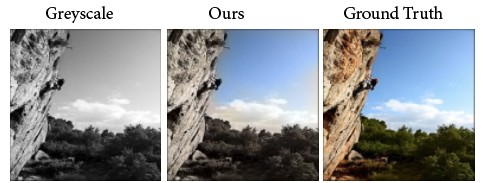
Repo output · grayscale / prediction / original
Problem
Explore whether a neural network can predict colour from a grayscale image, combining local image detail with high-level features.
What we built
Our three-person team reimplemented a published colorization approach with modifications: an encoder, a pretrained feature extractor, a fusion step and a decoder that predicts colour channels.
Decision / limit
Before broader training, we overfit one image to check the network wiring. Project time limited the ImageNet experiment to 2,000 images, so this is a small reproduction, not a claim of general performance.
Result / evidence
When we scaled training with precomputed features stored in TFRecords, the model produced brownish images. We suspected a TFRecords implementation problem, but did not confirm the cause. Our smaller mixed-class model handled grass and sky better than clothing details. The public repository contains notebooks, the architecture, output examples and a report. It does not establish production use or a measured improvement over a baseline.
Back to project
Case study